We advertise a new novel by Professor Emeritus David Pike.
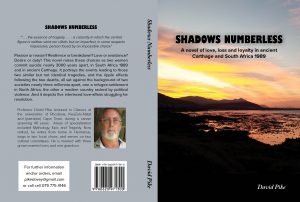
Synopsis: Two women commit suicide nearly 3000 years apart, one in ancient Carthage (in Tunisia), one in South Africa in the very violent year 1989; and the events leading up to and following the two suicides are portrayed. There are two story-lines: the modern South African one and the Carthaginian one, the latter written by one of the modern characters (so there is a novel-within-the-novel, with the two story-lines intertwining with each other). There are similarities, and differences, between the characters and events of the two story-lines. The two societies, one an early refugee-settlement and the other a modern one racked by political violence, form the background to what is mainly an examination of personal relationships; and there is some discussion of the challenges of writing fiction itself, especially the re-telling of a very ancient story (the Carthaginian) by a modern author.
The author is selling the novel privately in the Hermanus area for R180. The price for orders in the Cape Town area: (1) Postnet-to-Postnet: R250; (2) Postnet-to-street address: R300. For orders in other provinces, prices are: (1) Postnet-to-Postnet: R330; (2) Postnet-to-street address: R350.
Contact details: Cell: 079 775 4146. Email: pikedavey@gmail.com
Bank details: D.L. Pike, Nedbank Savings Account, Branch Code 198 765, Account Number 234 109 1660.
“I so enjoyed reading Shadows Numberless!
It is cleverly conceived and skilfully constructed; and it moves at a brisk pace, keeping the reader involved and curious.
The parallel narratives work well. In both cases there is an obviously beautiful sister and a plainer one, who nevertheless has strength of character and ultimately achieves an element of happiness – Anna, as a ruler; Caroline, with Patrick. In both cases the plainer sister is quietly attracted to the man who is besotted with the more attractive sister. In both cases there is male betrayal (Aeneas in relation to Elissa; an abusive father and the obnoxious Ivan Grossmann in relation to Janine).In both cases the perceived betrayal leads to destabilisation and self-destruction. I particularly enjoyed Patrick’s reworking of the Aeneas-Elissa story from Anna’s perspective. As she recalls, among other things, the arrival of Aeneas and the Trojans, Aeneas; account of the fall of Troy, the hunting party, and her sister’s death, her clear, uncluttered prose is both evocative and moving.
I think one is inclined to forget that Aeneas and his followers were refugees – one is so caught up in the heroics of the tale. I liked the emphasis on this fact – and that the Phoenicians (Elissa and Anna) were also refugees. Pertinent stuff, given current issues.”
~ Review by Moira Lovell, South African poet.